

The Holocaust
Postcard from Berta Smetana to her daughter, Lucy, written from Paris on 3 September 1939Lucie, for your birthday I wish you every good thing, and above all health, health, and once again health. I shall send you a present from Paris...
Our archive includes a collection of materials documenting the Holocaust, the systematic persecution and murder of six million European Jews by the Nazi regime. Through newly uncovered letters, postcards, photographs and survivor testimonies, learn more about life in life in ghettos and concentration camps as well as the experiences of Jewish refugees who sought asylum in Britain before the war.
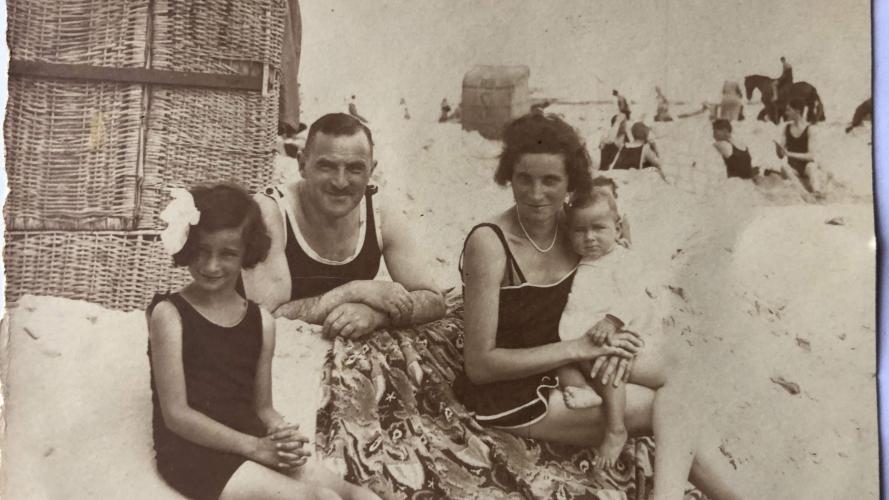
"Willy Friedlander was born in Berlin in 1878. Although he was Jewish, he felt himself to be a loyal German citizen, and fought in the German Army in the First World War. For this he was awarded the Honour Cross 1914-1918. This is sometimes known as the Hindenburg Cross because it was not awarded until 1934 when the Third Reich were trying to promote national pride.
Willy and his wife Lilli had two daughters, Dora and Gerda. Willy was a jeweler and owned a beautiful shop in Berlin. When Hitler came to power in the early 1930's they began to realise that life for Jews was going to become difficult, and after Willy's shop was destroyed on Kristallnacht in 1938 they decided they would have to leave."
Shared by Janet Ainley at Ahmadiyyah Mosque Hall, Warwickshire on 7 October 2023. The event was organised by Leamington History Group.
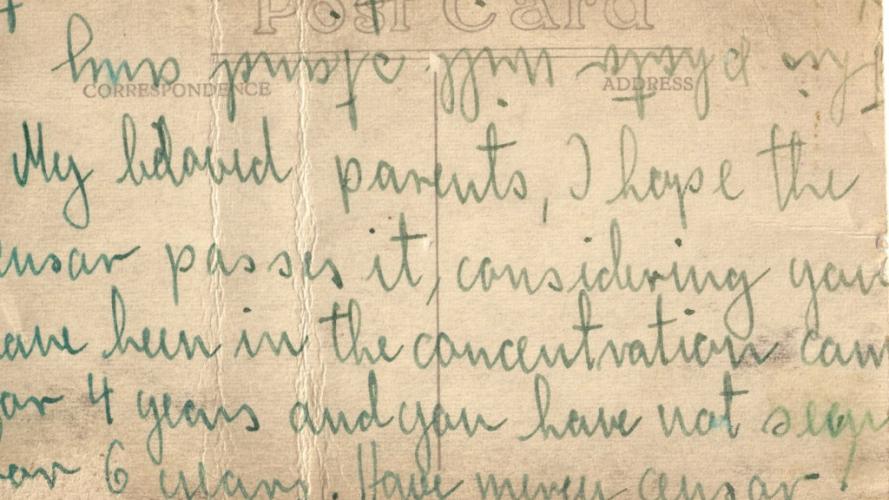
"As the war progressed, Max enlisted in the Auxiliary Military Pioneer Corps (AMPC), followed by the RAOC, and the REME. These German-speaking Jews were invaluable to the war effort and later dubbed by Churchill as the "King's Most Loyal Enemy Aliens". They wanted to show their gratitude to Britain for having taken them in and saving their lives. Meanwhile, back in Berlin, his parents and grandmother were deported to Theresienstadt concentration camp in December 1942. For six long years, Max had no news from his family, no idea if they were still alive or not. In 1945, he found out through the International Red Cross that his parents had survived. Barely. His grandmother Julie had been starved to death. He then sent his parents a photograph postcard of him in his Pioneer Corps uniform on the one side, and, on the reverse, he informed the censors he hadn't seen his parents in six years and that "his card would pass any X-ray"."
Shared by Judith Ellen Elam online via the Their Finest Hour project website.
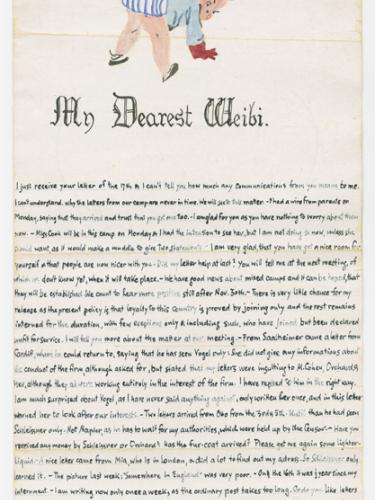
"My parents, who were Jewish, grew up in Vienna and left shortly after the Anschluss. They met in London, got married, and opened up a small textile factory in Cardiff. In 1940, they were interned as 'enemy aliens' in separate camps on the Isle of Man for a year. After this, they moved to Liverpool where I was born and we came to the U. S. in 1950."
"My mother kept my father's letters while they were interned. This package contains my father's letters, and my sister Kay's typed version of the letters so they are more readable."
Shared by Tony Hausner online via the Their Finest Hour project website.
"One of the associated objects, her Certificate of Registration as an alien, adds the name 'Sara' which was not her name but which she had been obliged to adopt by a Nazi law of 17th August 1938, as were all Jewish women with 'non-Jewish' names. (Men had to adopt the additional name 'Israel'.) This Certificate illustrates the extremely tight controls applied in Britain to 'enemy aliens', having to obtain dated and timed permission from the local police to leave their place of residence, then register both arrival and departure with the police local to their destination. Sometimes, Hilde was obliged to remain indoors within specified hours."
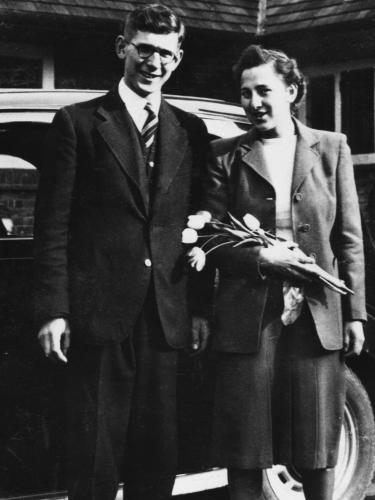
"Having decided to marry, John joined the Ministry of Agriculture to earn a wage and moved to Nottinghamshire. Hilde and John married on March 25th, 1944, and she had a new Identity Card issued in her married name (copy attached). Their wedding was a 'budget' affair, but someone found six tulips for a bouquet, and a single photograph was taken (attached). The 'bouquet' was kept for decades until it fell apart (photo attached). Hilde's father, Leopold, was named on their marriage certificate (attached). Of course, she did not know that he had died two years earlier in the Lodz ghetto in Poland."
Shared by Helen and Mike Norris online via the Their Finest Hour project website.